

I love setting goals. If there were a prize for “Best New Year’s Resolutions,” I’d spend five years iterating on the perfect plan to win it.
Alas. After years of detailing and refining, the data is in: I’m a much better planner than doer. In 2025 (and most previous years), I missed most of my marks. Last year, I worked out half as much as intended. I wrote exactly twice (the goal was…does that say weekly???).
There was a major win: I was more present as a dad - a feat made more impressive by the fact that my number of children doubled last March.
Looking back at the productivity wreckage, I’ve realized why my previous approaches to yearly goals failed:
I was too ambitious. That ”Aim for the stars” mantra is just bad physics. Missing the stars and landing on the moon only works if you’re already strapped into a ship with 10,000 pounds of rocket fuel. Without an accountability mechanism, you just drift. I mean, why even take off?
Focusing on outputs over outcomes ain’t it. It’s a trap. Outputs are just short-term outcomes. It was too easy to miss a week’s goal and tell myself I’d make it up on the weekend or next month. I didn’t. This is especially pernicious with those quarterly/weekly plans that ladder up into something bigger.
Atomic habits require a molecule. I love the theory, but habits without a larger structure felt like building bricks without a blueprint. Is the point the habit or what you achieve when you no longer have to focus on the habit? I got in the habit of identifying habits to build and then not building them, which I fear was not the point. (Disclaimer: I only read the first half of the book; see previous failed approaches).
What has worked is simpler: Putting intense attention on things I care about—regardless of the “output”—and starting projects without knowing where they would go. That’s how I’ve approached Historio and some of the projects I’m happiest with at work. It’s also generally how I’ve come to truly enjoy parenting, which is in all ways my #1 job.
The Constraint
So more of that focus. I figure I’ll have about 500 hours of personal “project” time in 2026. I call it my curiosity budget. 500 hours is about what’s leftover after a sober accounting of the things I’m not willing to sacrifice:
Parenting
Showing up as a friend/husband
Sleep
Run for Something work
Consulting work
Keeping the fam, myself, and the dogs fed and healthy
Keeping my house standing
In the past, my goals have centered on optimizing or expanding the curiosity budget. Every year, I wake up on New Year’s Day to a smaller budget. I feel constrained, and wish I’d optimized my time better in the previous year. I pour that energy into crafting a plan to do even more with even less in the year ahead.
This is a losing game. I can’t manufacture time. I can’t sacrifice the 7 things above. And, despite every productivity hack under the sun, I can’t further optimize my time to any meaningful degree.
So what to do?
The Plan
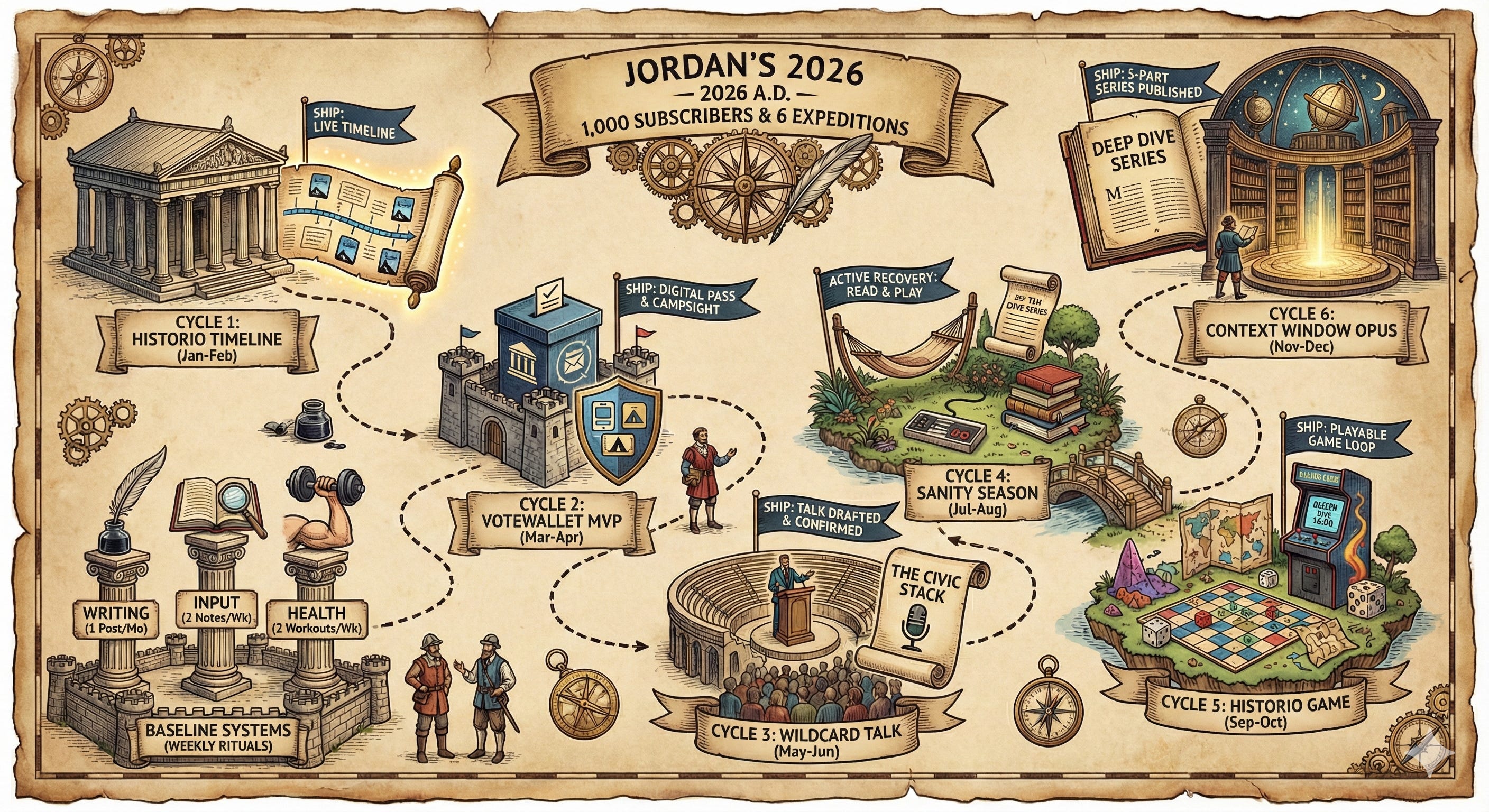
This year, I’m optimizing for what works: putting intense focus on a project I enjoy, given the limited time I have to enjoy it. I’m organizing the year into 6-week cycles, during which I will focus on one thing. I’m giving myself permission to pour myself into a single project for a few weeks, and permission to ignore the others (both permissions are difficult in practice).
It’s not all intention, though. There are a few systems (we’re not calling them atomic habits) to support my focus:
Limit distraction. I’ve finally allowed for the realization that I don’t control my attention. I want to scroll less on Reddit, The New York Times, Bluesky, and LinkedIn. So now they’re mostly blocked (and it’s mostly working). Thanks, StayFree.
Have Fun. The foremost priority in each cycle is to enjoy what I’m working on. Not to pick up a new skill. Not to build something that could make money later. Not even to do something worth writing about. So it’s okay (good even!) to spend time enjoying writing code rather than figuring out whether Claude can do it instead. It’s okay to build something I could sell and then…not sell it. It’s okay, even, to just play a lot of Xbox or dive deep into a history few care about (the world of 18th-century fur trade is fascinating, by the way).
Ship it and Talk About it. There are two ways I develop ideas and products: by writing about them (posts like this; product docs) and by talking about them (ideally in a coffee shop, but Slack works in a pinch). The goal of shipping each cycle isn’t to deliver a final/beautiful/impressive product but to publish something that I can use to figure out what’s next.
This year’s cycles are:
Historio Timelines (a.k.a. project Make Building Fun Again!)
A big swing on an AI-related product for Run for Something
Public Speaking on a Tech(ish) Topic
Guilt-free Summer Leisure (xbox and a few books)
Historio Round 2: Interactive maps or games (depending on what the timeline users want. Could be you!)
Writing (one of the billion deep dive series I’ve started)
Accountability
This week I started my first cycle. I’m building timelines in Historio. It’s a feature I’ve been dreaming of for 5 years: The ability to see all of my notes from all of my history books on a single timeline so that I can discover the coincidence of histories I’m already familiar with.
During this cycle, I’m trying hard not to second-guess whether I should actually be developing that exciting new product for Run for Something (Cycle 2) or exploring the impressive world of Elden Ring (Cycle 4). These types of thoughts have blocked me from moving forward with curiosity projects in the past (”Shouldn’t I be working on something that can make money?”; “If I’m working on a project anyway, shouldn’t it be something I can show off at work?”). With this year’s cycle structure, the time to explore those other projects (and answer those pesky questions) will come. But in each cycle, I have permission to obsess over a thing and ignore the rest.
Historio timelines, in some form, will ship by February 15th. Can’t wait to show you!